Is trauma-informed language ever useful on a homepage?
As supporting detail after you name who you help, yes. As the only differentiator, it blends into the crowd.
The Deeper 33
How do I stop sounding like every other therapist online?
Politeness is not positioning. When your hero repeats the same virtues as every colleague on page one of Google, clients cannot remember why your name belonged in the tab they closed. Trade slogan adjectives for one population, one setting, and one problem you are willing to name out loud.
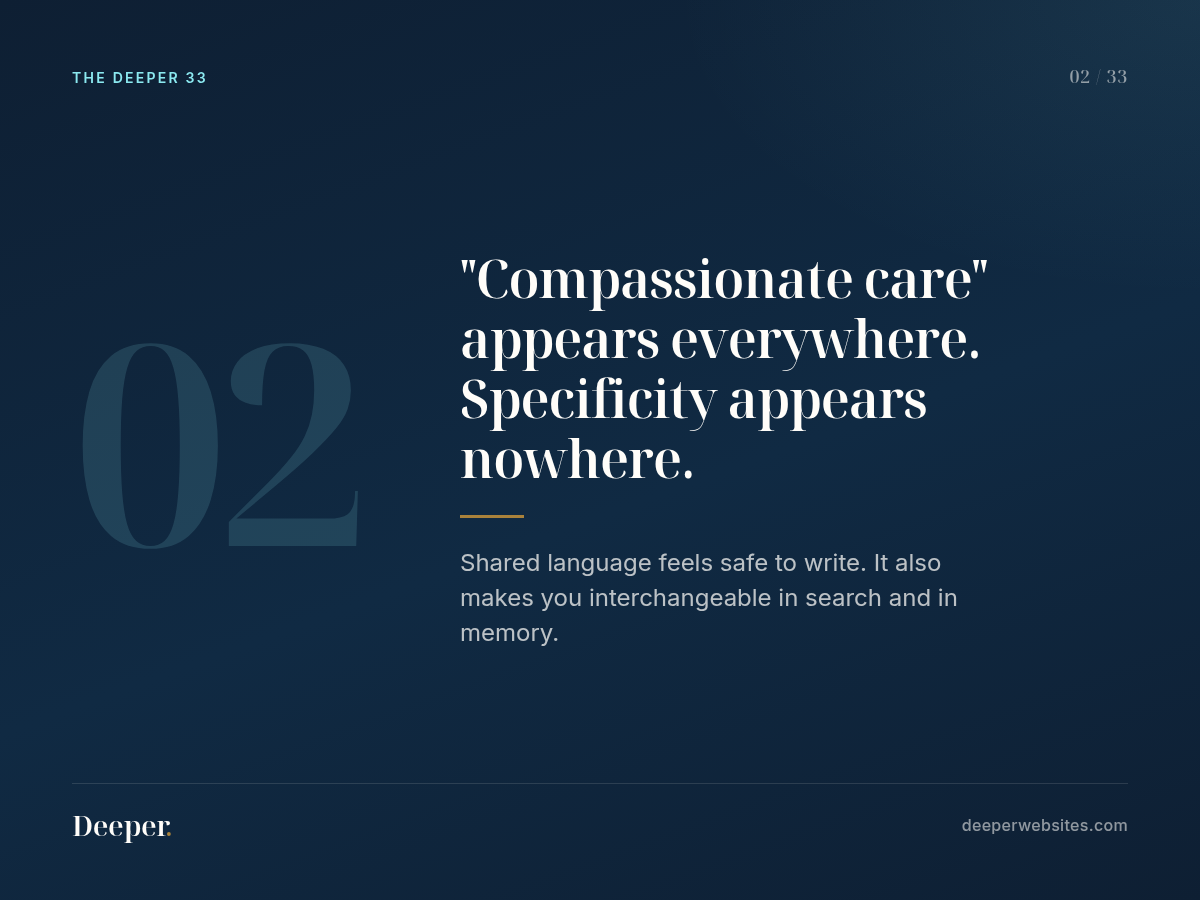
This is pattern 2 in The Deeper 33: “"Compassionate care" appears everywhere. Specificity appears nowhere.”
Book a free 20-minute strategy call
Prefer to talk? (404) 688-0088 , by appointment, Mon–Fri 9–5.
Judgment-free, holistic, and trauma-informed read as baseline expectations now—not reasons to choose you. They fill space without giving memory a hook.
Templates ship with these phrases pre-loaded. Launch day feels complete while every competitor launched the same paragraph in a different font.
Peer review often rewards safe language. Clients in crisis are not grading your copy for collegial tone; they are scanning for recognition.
Meta descriptions that could swap names still compete for the same queries. Search systems struggle to reward a page that differs only in the clinician photo.
Referral partners want a repeatable sentence. Nice and caring does not route a school counselor toward the clinician who handles school refusal.
After a consult that did not happen, clients rarely explain they could not picture themselves in your words. They simply open the next tab.
Large language models weight repeated phrases across your site and the broader web. Without named problems and populations, summaries default to generic mental health provider.
Structured data and FAQs amplify whatever language you repeat. Clinician jargon in markup teaches machines the wrong vocabulary for your practice.
Directories and your owned site often share the same adjectives. Overlap trains algorithms to treat you as interchangeable with every listing in your zip code.
Draft a single positioning sentence: who plus what situation plus how you work. Read it beside three local competitors; if it fits them, rewrite.
Place that line in the hero, the GBP description, and the first FAQ answer so every channel reinforces the same hook.
Replace modality bullets with links titled the way clients search: panic at work, affair recovery, ADHD and relationships—not just EMDR or IFS acronyms alone.
As supporting detail after you name who you help, yes. As the only differentiator, it blends into the crowd.
Describe populations, settings, and how sessions tend to unfold. Avoid guaranteeing cures; do promise clarity about fit and process.
It will filter mismatches—which protects your calendar. The right client often needs to see themselves before they dare to reach out.
Rick Julian (2026). Why does "compassionate care" make you invisible?. Deeper. https://deeperwebsites.com/the-deeper-33/compassionate-care-everywhere-specificity-nowhere
Canonical URL: https://deeperwebsites.com/the-deeper-33/compassionate-care-everywhere-specificity-nowhere
Book a free 20-minute strategy call. We will review your current site and talk through what a stronger signal could look like — without a pitch deck.
Prefer to talk? (404) 688-0088, by appointment, Mon–Fri 9–5.