Should I remove modality names entirely?
No. Clients who know EMDR or IFS will look for it. Lead with problems; place modalities where scanners can find them.
The Deeper 33
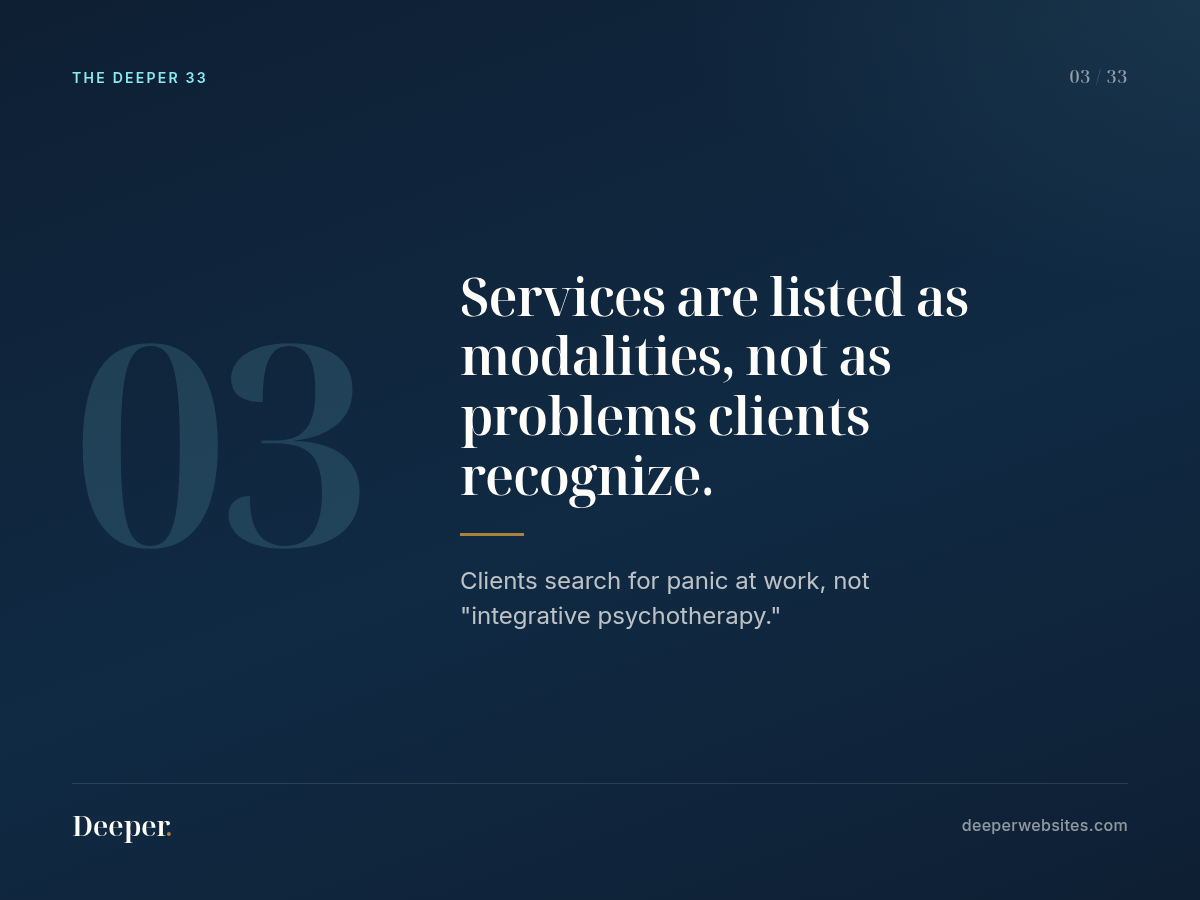
Should my website list modalities or problems clients search for?
Clients rarely search for integrative psychotherapy; they search for panic attacks before presentations or help after an affair. When your menu lists modalities, you ask visitors to translate clinical training into their pain. Lead with problems, then explain approach underneath.
This is pattern 3 in The Deeper 33: “Services are listed as modalities, not as problems clients recognize.”
Book a free 20-minute strategy call
Prefer to talk? (404) 688-0088 , by appointment, Mon–Fri 9–5.
A Services dropdown with twelve modality links looks thorough. To a new client it reads like a course catalog for a degree they do not have.
Some practices bury problem language in tiny subheads while modality names dominate the H1. Search engines see the heading you chose, not the footnote.
Group sites list the same modalities under every clinician because it was faster than writing distinct intake stories.
People bounce when they cannot map your list to their Tuesday night worry. They assume you are generalist by default and pick whoever names their issue first.
Referrers hesitate to send complex cases when the site only advertises techniques. They need language about situations: divorce, OCD, perinatal mood, not acronym soup.
Intake calls repeat the same translation work your website should have done: turning I do somatic work into so you help with panic in my body.
Ranking pages usually match a question: therapist for social anxiety, couples counseling after betrayal, teen therapy for school refusal. A single Services page rarely holds enough depth for all of them.
Internal links from problem-led pages to modality explainers build a graph search crawlers can follow. A flat modality list is a dead end.
AI overviews pull FAQ pairs. If your FAQs only define DBT, you miss the chance to be cited for the question clients actually ask.
Rename top-level links to client phrases; keep a shorter Approaches section that explains how you work underneath.
Build one page per high-intent problem you want this year, each linking to fees, location, and your bio.
On GBP services, mirror the same problem-first names so map pack clicks land on matching copy.
No. Clients who know EMDR or IFS will look for it. Lead with problems; place modalities where scanners can find them.
Start with the three intakes you want most. Depth beats a dozen thin pages.
Use careful, non-stigmatizing plain language about situations and symptoms, not diagnostic codes, unless your market truly searches that way.
Only if you clearly separate intents with subheadings and links. Mixed pages often rank for neither.
Rick Julian (2026). Should therapy services match client search language?. Deeper. https://deeperwebsites.com/the-deeper-33/services-listed-as-modalities-not-problems
Canonical URL: https://deeperwebsites.com/the-deeper-33/services-listed-as-modalities-not-problems
Book a free 20-minute strategy call. We will review your current site and talk through what a stronger signal could look like — without a pitch deck.
Prefer to talk? (404) 688-0088, by appointment, Mon–Fri 9–5.